Here
is a situation that plays out in Kampala every single day.
A
potential customer — maybe looking for a hotel in Jinja, a hardware shop in
Nateete, or a school in Entebbe — picks up their phone and types a search into
Google. Within seconds they are looking at three or four businesses that match
their need. They read brief descriptions, check contact details, maybe glance
at photos. They pick one. They call. They buy.
The
businesses that did not appear? They never knew the customer existed.
This
is not a hypothetical. Uganda now has over 21 million internet users,
representing more than 46% of the population, and that figure has grown by
double digits every year for the past five years (Uganda Communications
Commission, 2024). The majority of those users access the internet primarily
through mobile phones. They are searching for businesses like yours — and if
you are not findable, you are invisible.
This
guide explains exactly what not having a website costs you, why social media
alone cannot protect you, and what the realistic path to building your digital
presence looks like in Uganda — including what it actually costs.
1. The Real Cost of Being Invisible on Google
When
a customer cannot find you on Google, they do not wait. They move to the next
result.
Consider
how your own buying behaviour has shifted over the last few years. Before
spending money on anything significant — a repair, a school, a catering
service, an office supplier — most people now do a quick search first. They are
not looking for the cheapest option. They are looking for the most credible
one.
Google
processes approximately 8.5 billion searches every day globally. In Uganda,
mobile Google search has grown alongside smartphone adoption, which crossed 14
million active users in 2023 (GSMA Mobile Economy Sub-Saharan Africa, 2024).
The businesses that appear in those results are not necessarily the best — they
are simply the ones that invested in being findable.
What visibility actually means in practice
A customer searches "web design
company Kampala" — they find your competitor, not you.
A customer searches "affordable
school Wakiso" — if your school has no website, you are not in the
conversation.
A customer searches "hardware shop
near me" — Google shows businesses with a web presence first.
You lose not because you offered a worse
service. You lose because you were not there.
Not
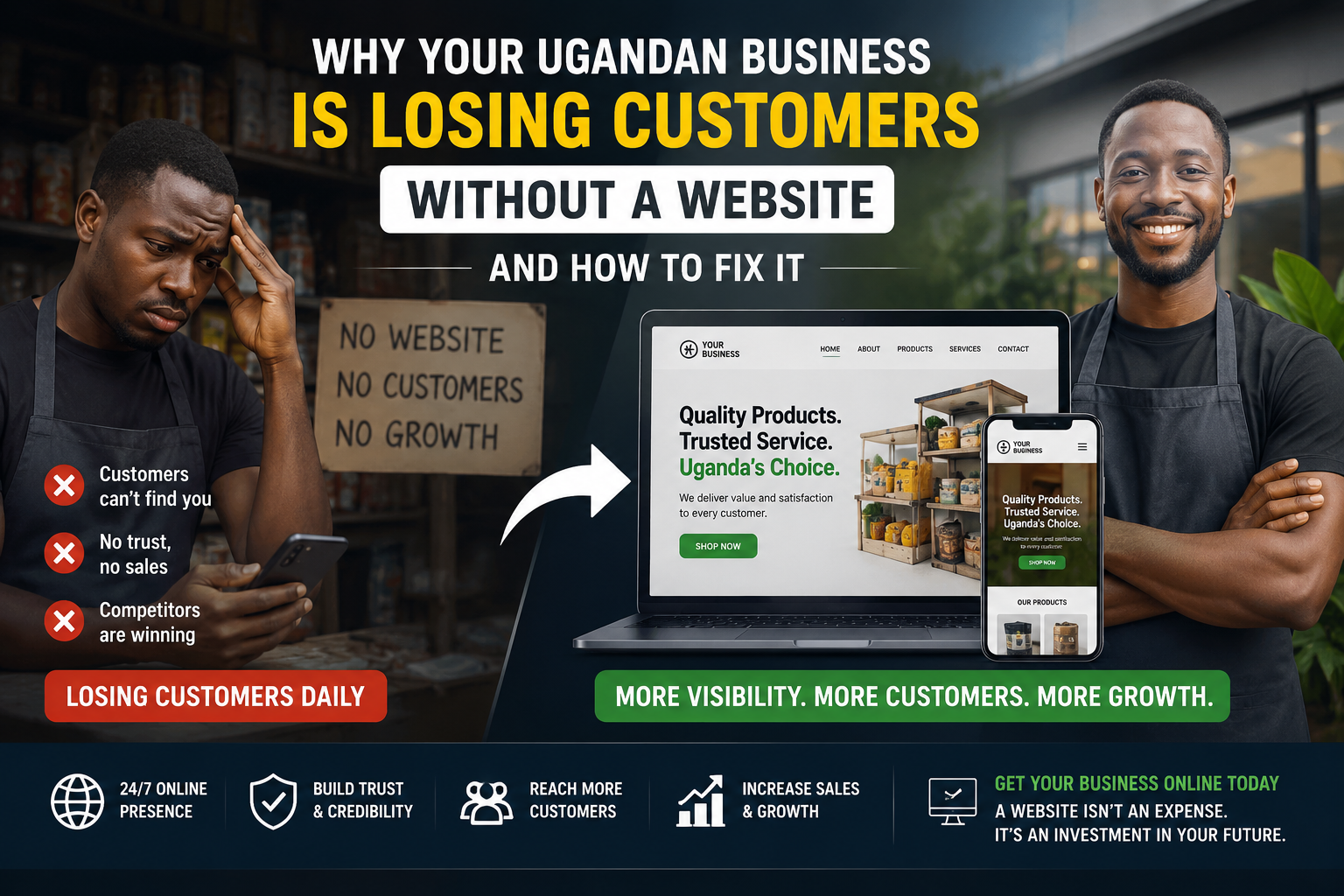
having a website is not a neutral decision. It actively removes you from the
most high-intent buying conversations happening in your market.
2. Why WhatsApp and Facebook Cannot Replace a Website
This
is the most common misconception among Ugandan small and medium businesses, and
it is worth addressing directly.
Facebook
pages, WhatsApp Business numbers, and TikTok accounts are genuinely valuable.
They help you reach people, share updates, and stay in touch with existing
customers. No serious digital strategy ignores them.
But
here is the fundamental problem: you do not own any of them.
In
2019, millions of Facebook business pages across Africa saw their reach drop by
60–80% overnight when Facebook changed its algorithm to prioritise paid
content. Businesses that had spent years building followings lost their ability
to reach customers without paying for every post. There was no warning and no
appeal.
WhatsApp
account bans for businesses perceived as sending bulk messages are routine.
TikTok accounts get restricted. Instagram changes what it shows. None of these
platforms owe your business anything.
What you own vs. what you rent
•
Your website: lives on a domain you own, under hosting you control,
indexed by Google independently of any platform's algorithm.
•
Your Facebook page: owned and controlled entirely by Meta. Reach is rented,
not guaranteed.
•
Your WhatsApp number: a communication tool, not a discovery channel. Customers
must already know you exist before they can message you.
•
Your TikTok or
Instagram: useful for awareness, but
content has a lifespan of hours, not years. And the platform can disappear or
restrict your account at any point.
A
properly built website compounds over time. A blog post you write today about
"best restaurants in Kampala" can still bring you customers three
years from now. A Facebook post from three years ago is effectively gone.
3. Trust Is Now Transactional — And Websites Build It
Something
has changed in how Ugandan consumers evaluate businesses, especially in urban
areas.
Five
years ago, a phone number and a referral from a friend were enough. Today, the
first thing many people do when they receive a business recommendation is
search for that business online. If they find nothing — no website, no Google
Business profile, no clear web presence — a significant portion of them will
quietly move on.
This
is not irrational behaviour. Uganda has seen an increase in business fraud,
fake suppliers, and counterfeit services, particularly in sectors like
construction, education, finance, and IT. Consumers have learned to verify
before they trust.
What a professional website signals to a potential customer
•
You are an established
business, not someone operating from a personal phone
•
You are confident enough in
your offering to describe it publicly
•
Your contact details,
location, and pricing are verifiable
•
You have been operating
long enough to invest in your digital presence
•
You are accessible even
outside of business hours
A real scenario
A mid-size NGO in Kampala is looking for
an IT company to implement a staff management system. Their procurement officer
receives recommendations for three companies. Two have websites with their
portfolio, team, and service descriptions. One has only a WhatsApp number.
Which company gets shortlisted? Almost
certainly the two with websites — regardless of price.
This plays out in every sector, every
week.
4. A Website Works for You 24 Hours a Day, 7 Days a Week
Your
staff work eight hours a day. Your website works every hour of every day.
While
you are asleep, while you are in a meeting, while you are handling another
client — your website is answering questions, showing your services, building
trust, and directing people to your WhatsApp or contact form. It is the most
cost-efficient member of your team.
What a well-built business website does automatically
•
Explains your services
clearly, so customers arrive already informed
•
Answers common questions
before they are asked (pricing ranges, turnaround time, service areas, process)
•
Collects enquiry forms or
booking requests while you sleep
•
Directs visitors to your
WhatsApp with a single click — turning web traffic into conversations
•
Builds your credibility
passively, every time someone searches for businesses like yours
The
businesses that grow fastest in Uganda right now are not necessarily the ones
working the hardest — they are the ones whose digital presence is doing work
for them automatically.
5. Mobile Money + Website = A Complete Customer Journey
Uganda
is one of the world's leading mobile money markets. According to the Bank of
Uganda's 2024 annual report, mobile money transaction values exceeded UGX 140
trillion in 2023 — a figure that continues to grow as smartphone adoption
rises.
This
matters enormously for businesses with websites, because it closes the entire
gap between discovery and payment.
The journey a customer can now complete entirely online
1.
Customer searches for your
service on Google
2.
They find your website,
read about your services, and see your pricing
3.
They click your WhatsApp
button or fill your contact form
4.
You confirm the order or
appointment
5.
They pay via MTN Mobile
Money or Airtel Money
6.
You deliver. They return
and refer others.
None
of this requires a customer to visit your physical location. None of it
requires office hours. And all of it starts with your website being findable.
6. The Sectors Where Ugandan Businesses Are Already Winning With Websites
This
is not theoretical. Across Uganda, businesses in specific sectors have seen
tangible, measurable benefits from building a proper web presence. Here are the
patterns we see most clearly from our own client work.
Schools and educational institutions
Parents
in Kampala, Wakiso, and Entebbe now routinely search for schools before
calling. Schools with websites showing their facilities, fee structures,
academic results, and admission process receive significantly more unsolicited
enquiries than those without. A school website also reduces the administrative
burden at the front desk — parents arrive already knowing what documents are
required, what term dates look like, and what fees apply.
Salons, spas, and beauty services
Google
searches like "best salon in Ntinda" or "hair salon near me
Kampala" return real, mapable results. A salon with a website showing its
services, pricing, and photos of work dominates this search space. Many salons
pair their website with a simple WhatsApp booking link and see their
appointment calendar fill with significantly less follow-up effort.
Hardware and building supplies
Contractors
and construction managers increasingly search for specific products online
before purchasing. A hardware supplier with a website listing their stock,
brands carried, and delivery areas captures this demand. Competitors who rely
only on walk-in traffic are invisible to this segment entirely.
NGOs and service organisations
Donors,
partner organisations, and government agencies now expect NGOs to have a
professional web presence before engaging. An NGO without a website will
frequently not be shortlisted for partnerships or funding, regardless of its
actual work. A website is effectively a prerequisite for institutional
credibility in this sector.
IT, consulting, and professional services
Any
professional service business — legal, accounting, IT support, consulting —
that does not have a website is giving away credibility to competitors that do.
Clients searching for IT support in Kampala, for example, will contact
businesses they can verify online first.
7. The "My Customers Don't Use the Internet" Myth
This
is the most common objection we hear, and it is worth examining honestly.
It
is true that not every customer in every market is Google-searching before they
buy. A market vendor in Owino does not need a website. A boda boda rider
serving a single neighbourhood does not need one either.
But
consider your actual customer profile. If your business serves:
•
Businesses rather than
individuals (B2B)
•
Middle-class or urban
consumers
•
Institutions — schools,
hospitals, NGOs, government agencies
•
Customers who travel or are
not from your immediate area
•
Anyone making a purchase
above UGX 100,000
...then
the probability that your customers are checking Google before they contact you
is high and rising. And for every one customer who searches and does not find
you, there is a competitor who built a website and captured them instead.
The real question is not "do my customers use the
internet?"
The real question is: "how many
customers am I losing to competitors who are findable online?"
That number is almost certainly larger
than you think, and it grows every month.
8. What Does a Business Website Actually Cost in Uganda?
This
is where many businesses get stuck, often because of outdated assumptions. The
cost of building a professional website in Uganda has come down significantly
over the past five years, and the return on investment for most businesses is
measurable within the first few months.
Realistic price ranges for Ugandan businesses (2025–2026)
•
Simple business website
(5–8 pages): UGX 470,000 – 900,000.
Covers home, about, services, contact, WhatsApp integration, mobile-optimised.
Suitable for most SMEs.
•
Professional business
website with blog: UGX 850,000 –
2,500,000. Adds a content management system, blog for SEO, gallery, enquiry
forms. Suitable for growing businesses, schools, consultancies.
•
E-commerce website: UGX 2,500,000 – 5,000,000+. Full online store with
product listings, cart, and Mobile Money payment integration. Suitable for
retail, wholesale, and product businesses.
•
Annual web hosting (VPS,
fast load speeds): UGX 950,000 – 240,000
per year. This keeps your site live, secure, and fast on Ugandan mobile
connections.
Put it in perspective
If your website brings you just one
additional client per month — whether a school, an NGO, a business, or a
regular customer — it has likely paid for itself within 60 to 90 days.
The question is not whether you can
afford a website. It is whether you can afford to keep losing customers to
businesses that have one.
9. What to Look for in a Web Development Company in Uganda
Not
all website developers in Uganda deliver the same quality, and knowing what to
ask for before you engage a developer will save you a significant amount of
money, time, and frustration.
Questions to ask before you sign anything
•
Do they understand
mobile speed in Uganda? Most Ugandan
users browse on MTN or Airtel mobile data. A website that loads slowly on a 3G
connection will lose customers. Ask specifically how they optimise for mobile
loading speed.
•
Can you update the
website yourself? A good website comes
with a content management system (CMS) that lets you update text, images,
prices, and blog posts without calling the developer every time.
•
Do they handle hosting
and domain, or just the design? Some
developers only design and hand over files. Others manage the full setup
including domain registration, hosting, SSL certificates, and email. Understand
exactly what is included.
•
Do they do basic SEO
setup? At minimum, your website should
be submitted to Google Search Console, have proper meta titles and
descriptions, and load with an SSL certificate (the padlock in the browser).
Many cheap websites skip all of this.
•
What happens after
launch? Ask specifically about
maintenance, security updates, and what support looks like if something breaks.
A website with no maintenance plan will start failing within months.
10. Starting Today: A Realistic Roadmap
If you are convinced and ready to move, here is the practical sequence that works for most Ugandan businesses.
7.
Register your domain
name first. Choose a .com or .co.ug
domain that matches your business name. This is your permanent digital address.
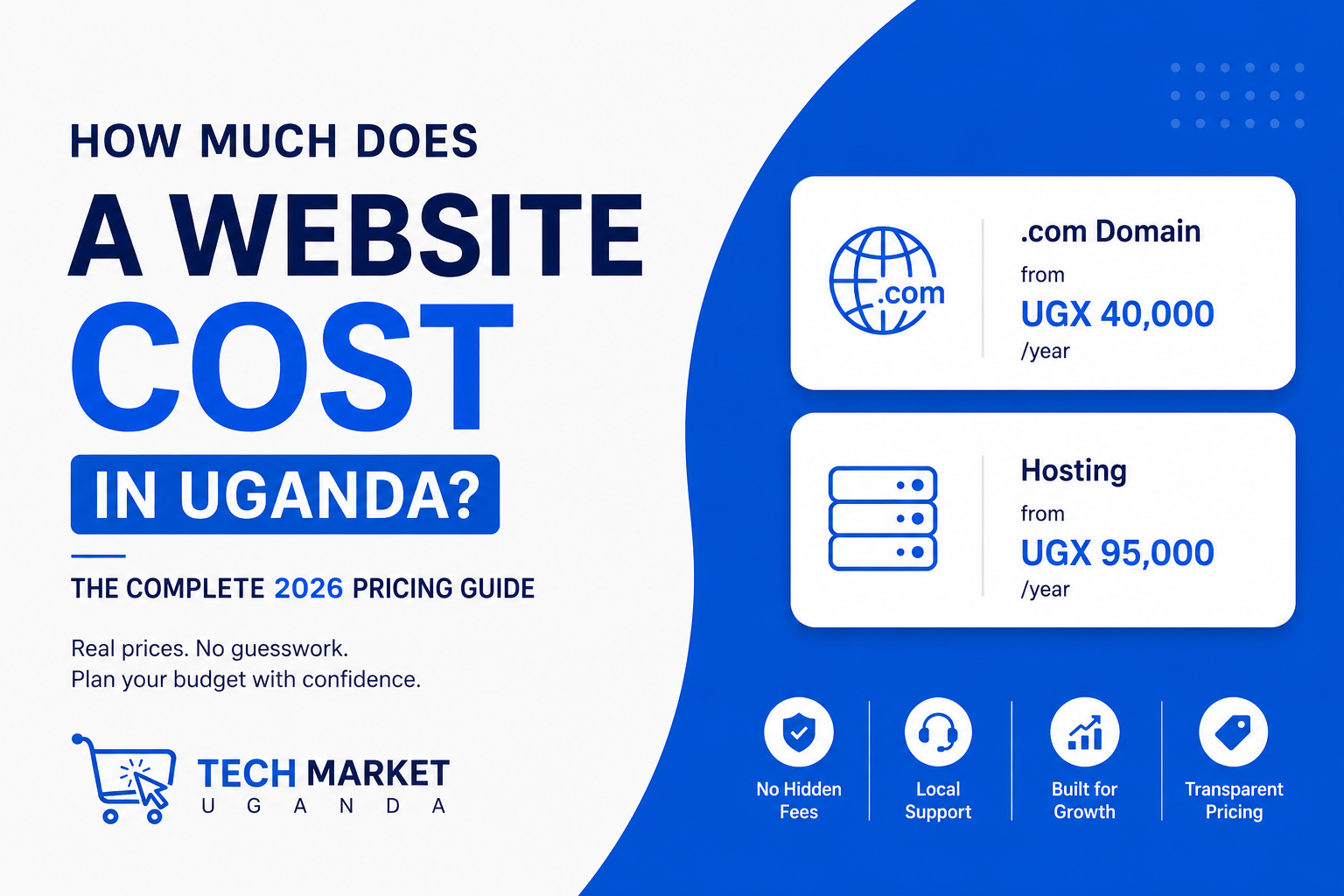
It typically costs UGX 40,000–100,000 per year.
8.
Decide what your website
needs to accomplish. Is the primary goal
generating enquiries? Booking appointments? Showing your portfolio? Selling
products? Being clear on this shapes every decision that follows.
9.
Choose a developer who
asks the right questions. If a developer
gives you a quote without asking about your business goals, your customers, or
your intended updates process, that is a warning sign.
10. Set up your Google Business Profile in parallel. This is free and ensures you appear in Google Maps
searches in your area. It complements your website and takes about 30 minutes
to complete.
11. Plan for at least one blog post per month after launch. A website without content grows stale in Google's eyes.
Even one post per month — answering a common question your customers have —
compounds your search visibility significantly over time.
Frequently Asked Questions
How much does a website cost in Uganda?
A
professional small business website in Uganda typically costs between UGX 470,000 and 2,500,000 for design and development, plus UGX 95,000–600,000 per
year for hosting. E-commerce websites start from around UGX 2,500,000. Costs
vary based on the number of pages, features required, and the experience level
of the developer.
Do I need a website if I already have a Facebook page?
A
Facebook page is a useful tool for engagement, but it cannot replace a website.
You do not own your Facebook page — Meta controls your reach and can restrict
your account. A website belongs to you, is indexed by Google, and works as a
permanent, discoverable digital home for your business. The two should work
together, not substitute for each other.
How long does it take to build a website in Uganda?
A
standard small business website typically takes two to four weeks from start to
launch, assuming content (text and photos) is provided by the client in the
first week. More complex websites with e-commerce or custom functionality take
four to eight weeks.
Will people in Uganda actually find my website on Google?
Yes
— provided the website is properly optimised for search (correct meta titles,
fast loading, mobile-friendly, submitted to Google Search Console). Many
Ugandan businesses rank well in local searches simply because competition at
the local level is still relatively low. Acting now, before your market becomes
saturated with website-equipped competitors, gives you a lasting advantage.
Can I update the website myself after it is built?
This
depends entirely on how the website is built. A properly built website should
include a content management system (CMS) that lets you update text, images,
prices, and blog posts without developer assistance. Always confirm this before
you engage a developer.
Tech
Market Uganda has helped businesses across Kampala and Uganda build
professional, fast, SEO-ready websites that generate real enquiries and grow
revenue.
We
build websites from UGX 470,000, fully mobile-optimised, Google-ready,
and connected to your WhatsApp — with local hosting that loads fast on Ugandan
data connections.
What you get with Tech Market Uganda
•
Professional web design and development — built to your business goals, not a template
•
SEO setup and Google submission — so customers find you from day one
•
Web hosting and domain registration — fast, reliable, locally supported
•
E-commerce development
— with Mobile Money integration for Ugandan buyers
•
Ongoing website maintenance — so your investment stays secure and up to date
•
IT consultancy —
if you are not sure where to start, we help you figure that out first
Start today: www.techmarketug.com/services/web-design | WhatsApp: +256 776 121 422 | [email protected]
About Tech
Market Uganda